
Test Methods
ELECTRICITY AND MAGNETISM
Electrical and Electronic Test Equipment
Method Used: CATS Internal Test Methods based on Euramet Calibration Guidelines No. 15 | Guidelines on the Calibration of Digital Multimeters |TC-EM | Version 3.0, 02/2015 and Fluke Calibration:Philosophy in Practice Second Edition
INSULATION TEST EQUIPMENT
Method Used: CATS Internal Test Methods based on SANAS TG-02-02 Guidance on the Calibration of Insulation Testers | Euramet Calibration Guidelines No. 15 | Guidelines on the Calibration of Digital Multimeters |TC-EM | Version 3.0, 02/2015 and Fluke Calibration:Philosophy in Practice Second Edition
Oscilloscopes
Method Used: CATS Internal Test Methods based on Euramet Calibration Guidelines No. 7 | Guidelines on the Calibration of Oscilloscopes | TC-EM | Version 2.0, 09/2025
THERMOMETRY
Infrared Thermometers and Thermal Imagers
Method Used: CATS Internal Test Methods based on MSL Technical Guide 22, MSL Technical Guide 26, MSL Technical Guide 29
DIGITAL TEMPERATURE INDICATORS AND SIMULATORS
Method Used: CATS Internal Test Methods based on Euramet Calibration Guidelines No. 11 | Guidelines on the Calibration of Temperature Indicators and Simulators by Electrical Simulation and Measurement | TC-T | Version 2.0, 03/2011
DRYWELL TEMPERATURE BLOCK CALIBRATORS
Method Used: CATS Internal Test Methods based on Euramet Calibration Guidelines No. 13 | Guidelines on the Calibration of Temperature Block Calibrators | TC-T | Version 4.0, 09/2017
PRESSURE
Digital Pressure Instruments
Method Used: MSA Test Method 1
MECHANICAL Pressure Instruments
Method Used: MSA Test Method 2
Accuracy Spec: Manufacturer's specification, or based on dial size as defined in MSA Test Method 2
GUARDBANDING
By default we will assess your item against the manufacturers specifications where available. The decision rule for statements of conformity is based on the “Zero Guard Band Rule” and “Simple Acceptance” in accordance with ILAC-G8:09/2019, unless otherwise specified in the applied standard or requested by the customer. This means that measurement uncertainty is not taken into account with the conformity.
Any statement of conformity shall be reported as:
Pass – the measured value is below the acceptance limit
Fail – the measured value is above the acceptance limit
If you require a different guard banding rule applied to your calibration let us know and we can advise on how this will occur.
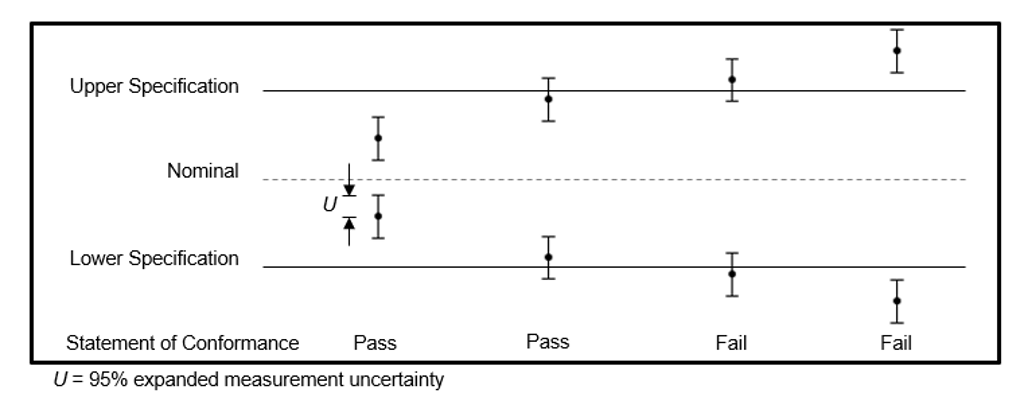
ILAC-G8:09/2019 Guidelines on Decision Rules and Statements of Conformity, Binary Statement of Simple Acceptance Rule
FREQUENTLY ASKED QUESTIONS
What is calibration?
Operation that, under specified conditions, in a first step, establishes a relation between the quantity values with measurement uncertainties provided by measurement standards and corresponding indications with associated measurement uncertainties (of the calibrated instrument or secondary standard) and, in a second step, uses this information to establish a relation for obtaining a measurement result from an indication. In plainer language, this means calibration is the process of comparing a measuring instrument (the "device under test") against a known, traceable reference standard of higher accuracy. Documenting the relationship between the instrument's readings and the true values (including uncertainties). Determining how to interpret or correct the instrument's indications to obtain reliable measurement results.
Why is calibration important?
Calibration is critically important because it directly underpins trustworthy measurements, which are the foundation for quality, safety, reliability, compliance, and efficiency across virtually every field that relies on data or quantitative decisions — from manufacturing and engineering to healthcare, aerospace, pharmaceuticals, scientific research, and more.
How often do I need to calibrate my equipment?
Periodic testing is recommended, but a time period cannot be given unless specifically requested by you, or is a legal requirement. To determine the re-calibration interval, a number of factors need to be considered:
importance of measurements
manufacturer recommendations
operating environment
historical stability of the equipment
regulatory requirements
NATA has published guidelines for general equipment calibration intervals: https://nata.com.au/files/2021/05/General-Equipment-Table.pdf
Typically, our clients have their equipment calibrated on a 1-year recurring schedule. Ultimately it is up to you and your quality system to determine the best calibration schedule for your particular needs based on the above factors, and we are happy to discuss these with you.
What is traceability?
The globally accepted definition comes from the International Vocabulary of Metrology (VIM), maintained by the BIPM (International Bureau of Weights and Measures) and other international bodies (JCGM 200:2012, clause 2.41):
Metrological traceability is the property of a measurement result whereby the result can be related to a reference through a documented unbroken chain of calibrations, each contributing to the measurement uncertainty.
In other words: Your measurement isn't floating in isolation — it has a clear, documented "family tree" of comparisons (calibrations) leading back to a known, authoritative reference (most often units of the International System of Units, or SI, like the metre, kilogram, second, ampere, etc.).
Why use a NATA accredited facility?
NATA (National Association of Testing Authorities) rigorously assesses labs against ISO/IEC 17025 — the international standard for testing and calibration competence. This includes:
Technical expertise and validated methods.
Proper equipment, environment control, and uncertainty calculations.
Impartiality, quality management systems, and ongoing proficiency testing. It's not self-declared; NATA auditors (often peers from other labs) verify everything through on-site assessments. This gives you confidence that the calibration is done right, consistently, and to the highest standards.